Inspired by websites like OriginEU, imagine a new entrepreneur in a random country of the European Union. This person has a vision: building the next-generation e-commerce business built entirely on European technology. Let’s call is ‘Company EU‘. It’s a bold idea but can it work? What are the strengths and weaknesses of such a European Stack business plan?
In a world where 90% of search queries flow through Google and three US hyperscalers control 70% of the cloud market, could a business not only survive but dominate using only European tools? And now, with AI-powered search engines like ChatGPT, Gemini, Mistral’s Le Chat and Perplexity reshaping discovery, the stakes were even higher.
This isn’t just a story about avoiding Big Tech. It’s about redefining competitive advantage in an era where digital sovereignty, AI-driven discovery, and ethical consumerism are converging to create a new frontier in commerce.
The AI-Search Revolution: Why Traditional SEO Is No Longer Enough
The rise of AI-powered search marks a tectonic shift in how consumers discover products. For e-commerce businesses, this means visibility is no longer just about ranking on a search engine results page—it’s about being the source AI tools trust.
Consider the implications: When a user asks an AI chatbot, “What’s the best sustainable sneaker brand in Europe?”, the response isn’t a list of links: it’s a single, curated recommendation. If Company EU isn’t optimized for this new reality, it risks invisibility in the very channels where future customers will search. But if it leads in AI-search optimization, it could outmaneuver competitors still playing by the old SEO rulebook.
The key lies in three strategic pivots:
- Structuring data for AI consumption: This means going beyond traditional HTML markup and SEO but ensuring that product pages are machine-readable with rich context. This will allow AI tools to pull accurate, up-to-date information and match it against user-generated questions. For example, a product description optimized for AI might include the unique selling points of the product, comparative pricing, and how the product would be useful or adapted to specific audiences.
- Optimizing for conversational queries: Unlike keyword-based SEO, AI-search optimization requires natural language content that answers questions directly. This could involve creating comprehensive FAQs, comparison tables, and buying guides that align with how people actually ask questions in conversation. According to a 2026 study by Gartner, 60% of all search queries will be voice- or chat-based by 2027, making this shift non-negotiable
- Partnering with AI platforms: Businesses that proactively work with European AI developers (like Mistral or Aleph Alpha) to integrate their product catalogs into AI knowledge bases will have a first-mover advantage. Imagine a scenario where Le Chat, powered by Mistral’s open-source models, recommends Company EU’s products not just as a search result, but as a trusted, contextual suggestion within a chat interface. That’s the future of discovery—and it’s happening now.
Such European LLM companies like Mistral are also growing fast as they are becoming viable options for enterprises frustrated by high inference costs, and regulatory constraints when deploying frontier LLMs. In the last 2 years, these competitors to ChatGPT and Gemini have struck up business relationships with actors in specific service sectors: government/defense (22%), finance (19%), healthcare (7%), and law (4%). Ecommerce could be next?

The European Stack Business Plan: A Double-Edged Sword
Building Company EU on a fully European infrastructure (using tools like OVHCloud for hosting, Proton for email and storage (100M+ users), and building an ecommerce strategy around Ecosia or Qwant for search) offers unparalleled advantages in sovereignty, privacy, and ethical branding. Yet, it also presents unique challenges that require careful navigation.
The Strategic Advantages of Sovereignty
The most compelling argument for a European tech stack business plan is digital sovereignty. By hosting with OVHCloud or Scaleway, Company EU ensures that all customer data remains within the EU, eliminating the legal and reputational risks associated with US surveillance laws like the CLOUD Act. In an era where 78% of European consumers say data privacy influences their purchasing decisions, this isn’t just compliance: it’s a brand asset.
Then there’s the ethical dimension. Tools like Proton Mail and Ecosia aren’t just functional alternatives to Gmail or Google: they’re symbols of a broader movement toward privacy and sustainability. For a generation of consumers who distrust Big Tech and prioritize ethical consumption, these choices resonate deeply. Company EU isn’t just selling products; it’s selling a vision of commerce that aligns with European values.
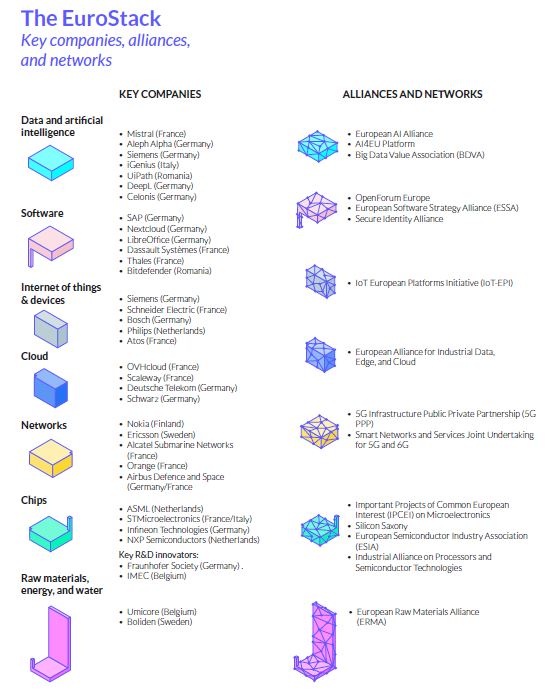
Finally, there’s the innovation opportunity. European cloud providers are investing billions of euros in AI and building competition from American hyperscalers, with OVHCloud crossing €1B in annual revenue and Scaleway launching quantum computing initiatives. In 2026, Europe is on a quest for digital sovereignty and homegrown tech with initiatives like the EuroStack.
The Challenges of Going Against the Grain
Yet, the path for a European Stack business plan isn’t without obstacles. The most immediate is scale. US hyperscalers like AWS and Azure offer unmatched global infrastructure, while European providers—though growing rapidly—still lag in data center footprint and service breadth. For a business with ambitions beyond Europe, this could mean higher latency and limited scalability in markets like Asia or the Americas. This is why 80% of e-commerce tools (Shopify, Salesforce, HubSpot) are built to integrate with AWS or Azure, meaning custom development is often required for EuroStack alternatives—increasing costs by 20-30%.
Then there’s the integration complexity. Most e-commerce tools—from Shopify to Salesforce—are built to integrate seamlessly with US cloud providers. Switching to OVHCloud or Scaleway often requires custom development, which can increase costs and extend timelines. For a startup, this might be a non-starter. For an established business, it’s a calculated risk.
Talent is another consideration. The vast majority of cloud engineers are trained on AWS, Azure, or Google Cloud. Finding experts who can optimize for OVHCloud or Scaleway is harder—and often more expensive. This isn’t just a hiring challenge; it’s a cultural shift that requires rethinking how teams are built and trained.
Marketing in a Post-Google World: Where to Find Your Customers
If search engines are no longer the primary driver of discovery, where should Company EU focus its marketing efforts? The answer lies in a multi-channel strategy that leverages European social networks, influencer partnerships, and offline experiences and prepare for the AI-search future.
European Social Media: The Untapped Opportunity
While Facebook and Instagram dominate global social media, Europe has its own thriving, privacy-focused alternatives. Platforms like Mastodon (a decentralized, ad-free alternative to X) have seen rapid growth, particularly among tech-savvy and privacy-conscious users. For Company EU, this represents an opportunity to build a loyal community without relying on Meta’s algorithms.
Then there’s PeerTube, a decentralized video platform or Dailymotion and Vimeo that offers European alternatives to YouTube. While their audiences are smaller, they can be highly engaged and more receptive to ethical brands or local European concerns. By creating authentic, localized, value-driven content, Company EU can drive organic growth in a way that’s harder to achieve on mainstream platforms.
The Power of European Retailer Affiliations
One of the most underutilized yet high-impact strategies for sovereign e-commerce is partnering with established European retailers. By affiliating with local and regional marketplaces, Company EU could tap into existing customer bases while reinforcing its European identity. Some of the marketplace the company could integrate with could include: Zalando (52M+ active users), About You (645K monthly visitors), and Veepee (51M+ European members) who dominate European e-commerce.
Affiliating with European retailers reduces dependency on US-controlled discovery channels while building credibility with local consumers. It’s a win-win: Retailers get fresh, ethical products, and Company EU gets scalable distribution.
Offline and Experiential Marketing: The Human Touch
In a digital-first world, offline strategies can be a powerful differentiator. Pop-up shops in eco-conscious cities like Berlin, Amsterdam, or Copenhagen allow Company EU to create tangible brand experiences. Collaborations with local makers and artisans can yield exclusive product lines that resonate with European pride.
Sponsoring sustainability conferences or privacy workshops positions Company EU as a thought leader and not just a retailer. These real-world touchpoints build credibility in ways that digital ads simply can’t.
Final Analysis of the hypothetical ecommerce Company EU
The strengths of Company EU would lie in first-mover advantage: the early adoption of AI-search optimization and European cloud sovereignty. It would position Company EU as a pioneer in ethical commerce, appealing to 73% of European consumers who prioritize data privacy and ethical values. The use of Proton for encrypted communications, Ecosia for sustainable search, and OVHCloud for GDPR-compliant hosting builds unmatched brand trust, particularly among Gen Z and millennial shoppers who demand transparency.
However, weaknesses include limited global scalability compared to US hyperscalers, higher integration costs for European cloud tools, and a talent gap in engineers skilled with OVHCloud or Scaleway. These challenges are mitigable through strategic partnerships and upskilling but require upfront investment.
There are great opportunities where a startup like Company EU could dominate though:
- The large European investment in AI and green cloud infrastructure opens doors for cost-effective, sovereign hosting and cutting-edge AI integrations.
- Affiliations with European retail giants like Zalando or About You offer instant access to millions of shoppers, while co-branded collections can drive 30-50% higher conversion rates. Ethical influencer marketing and offline pop-up experiences further amplify reach.
Threats remain from US hyperscalers’ dominance in AI and cloud, but European regulatory tailwinds (e.g., EuroStack, Digital Markets Act, GDPR) and growing consumer distrust of Big Tech create a protective moat. By optimizing for both Le Chat and other AI-Search players, Company EU could future-proof its discovery strategy while mitigating risks.
If you are interested in this kind of analysis or keen to explore ways to build a European Stack business plan for your startup, don’t hesitate to contact us.